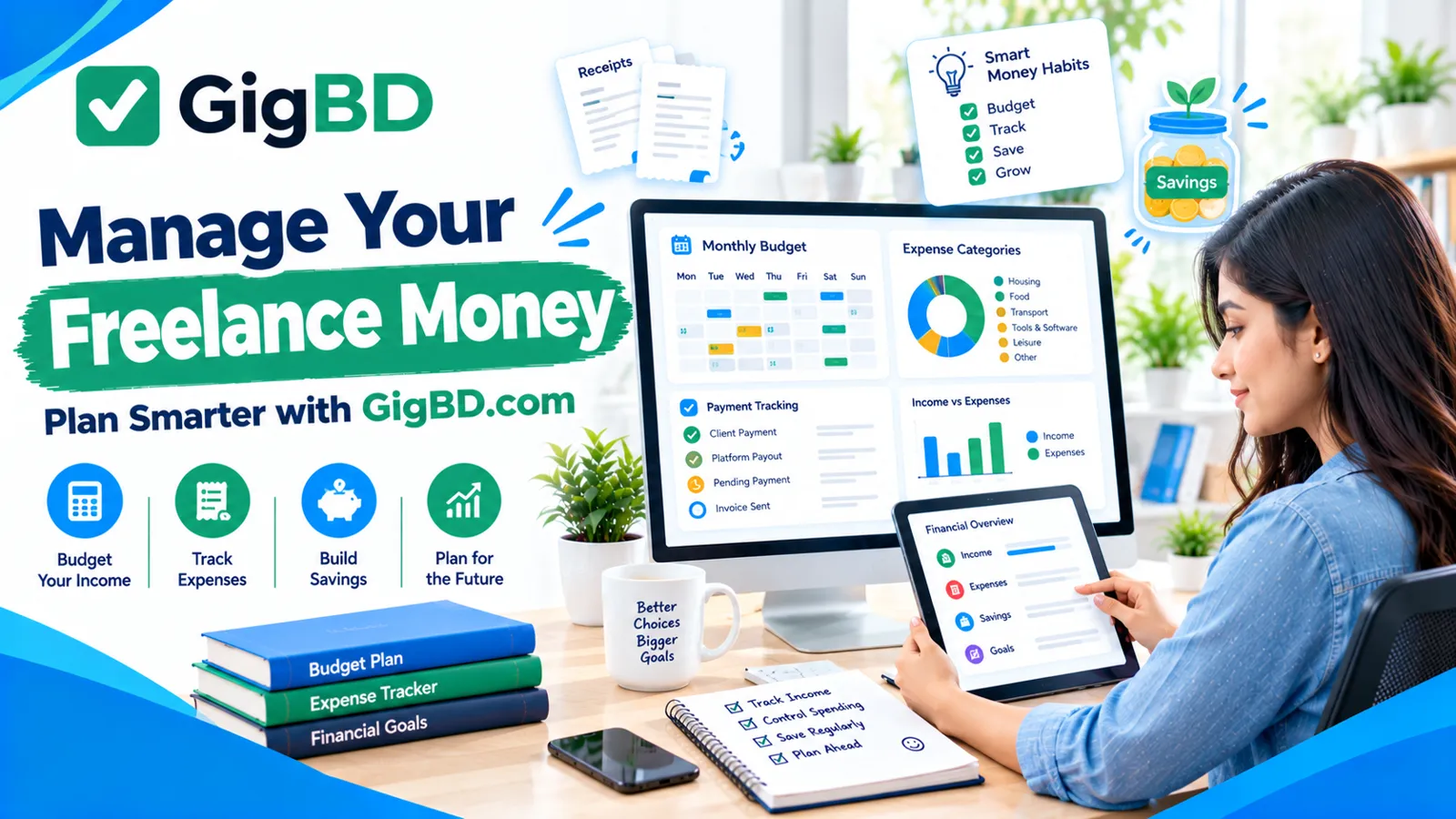
How to Manage Your Money as a Freelancer: A Beginner's Guide
Introduction
Freelancing offers flexibility, independence, and opportunities to work with different clients. However, managing money as a freelancer can be challenging because income may change from month to month.
Some months may bring several projects, while others may be quieter. Payments can also arrive at different times, making it difficult to plan expenses without a clear system.
Good money management does not require complicated financial software. A simple budget, accurate records, and consistent saving habits can help you understand where your money goes and prepare for future expenses.
At GigBD.com, we share practical educational resources for people exploring digital skills, online work, and freelancing. This guide explains how beginners can build healthier financial habits while managing freelance income.
1. Understand Your Freelance Income
The first step is to understand how much money you actually receive.
Freelancers may earn through hourly work, fixed-price projects, recurring clients, or individual online tasks. Each arrangement can have different payment schedules and fees.
Keep a record of:
Project or task name.
Amount earned.
Date the work was completed.
Expected payment date.
Actual payment received.
Platform or transaction fees.
Final amount received.
For example, if you complete three projects in a month, record each payment separately rather than relying on memory.
Distinguish between money you have earned, money that has been approved, and money that has actually arrived in your account. These amounts may not be the same.
If you use online work platforms, review their payment terms and withdrawal conditions carefully.
Readers discovering digital work through GigBD.com can benefit from building this record-keeping habit from the beginning.
2. Create a Realistic Monthly Budget
A budget helps you decide how to use the money you receive.
Start by listing your essential expenses, such as food, housing, utilities, transportation, internet access, and necessary work equipment.
Then record other expenses, including entertainment, subscriptions, shopping, and optional purchases.
You can organize your budget into four broad categories:
Essential expenses: Costs needed for daily living.
Work-related expenses: Internet, software, equipment, and other legitimate work costs.
Savings: Money reserved for emergencies or future goals.
Flexible spending: Nonessential purchases that can be adjusted when income decreases.
Your budget should reflect your actual circumstances rather than an idealized income level.
If your freelance earnings are irregular, build your essential budget around a conservative estimate of what you can reasonably expect to receive.
Do not assume that an unusually successful month will be repeated every month.
3. Separate Personal and Business Expenses
When possible, maintain separate records for personal spending and freelance business expenses.
Some freelancers use separate bank accounts, while others use dedicated spreadsheets or bookkeeping applications. Choose a method that is practical and appropriate for your location.
Track work-related costs such as:
Internet service used for work.
Software subscriptions.
Equipment and accessories.
Professional training.
Relevant platform fees.
Other legitimate business expenses.
Keep receipts or transaction records where appropriate.
Separating expenses makes it easier to understand how much your work costs and how much income remains after those expenses.
Tax rules vary by country, so check the requirements that apply to your circumstances rather than assuming every expense is tax-deductible.
4. Build an Emergency Fund
Freelance work can fluctuate. An emergency fund may help you handle unexpected expenses or periods when fewer projects are available.
Start with a manageable savings target. Even small, consistent contributions can help you develop the habit.
Over time, you might work toward saving enough to cover several months of essential expenses, depending on your circumstances and income stability.
Consider keeping emergency savings somewhere secure and reasonably accessible.
Avoid treating money reserved for rent, bills, or emergencies as available spending money.
If you are just beginning to earn online, do not feel pressured to build a large fund immediately. Start with an amount you can realistically set aside.
At GigBD.com, our educational content encourages online workers to think about long-term stability rather than focusing only on their next payment.
5. Prepare for Irregular Payments
One of the most difficult parts of freelancing is that completed work does not always translate into immediate cash.
A client may have a payment schedule, a platform may require approval, or a withdrawal may take additional time.
To manage this uncertainty:
Check payment terms before accepting a project.
Record expected payment dates.
Follow up professionally when a payment is overdue.
Avoid spending money before it is received.
Maintain a reserve for essential expenses.
Keep records of fees and withdrawal requirements.
If a platform shows earnings that are not yet withdrawable, do not treat that balance as cash already available to you.
For example, an account balance may include pending earnings, approved earnings, and spendable funds. Understand the platform's definitions before planning your budget around them.
This distinction is useful for anyone using online work platforms, including people learning about digital opportunities through GigBD.com.
6. Track Your Spending Every Week
Small purchases can add up over time. Reviewing your spending regularly helps you identify patterns and adjust your budget.
You can use a spreadsheet, notebook, or budgeting application.
Record the date, expense category, amount, and payment method. Then review the totals at the end of each week.
Ask yourself:
Which expenses were necessary?
Did I pay for unused subscriptions?
Were there unexpected costs?
Can I reduce any recurring expense?
Is my current spending consistent with my income?
The purpose is not to eliminate every enjoyable purchase. It is to understand your spending and make deliberate decisions.
A short weekly review is often easier to maintain than trying to reconstruct an entire month's spending from memory.
7. Set Aside Money for Taxes
Depending on your country and work arrangement, freelance income may be subject to income tax or other reporting requirements.
Do not assume that a platform's payment automatically covers all your tax obligations.
Learn which rules apply to your situation and keep appropriate records of income and eligible expenses.
You may choose to reserve a portion of each payment for future tax obligations, but the appropriate amount depends on your location, income, and circumstances.
If you are uncertain about the rules, consult official tax guidance or a qualified professional.
Freelancers in Bangladesh should check the relevant National Board of Revenue guidance and applicable tax rules for their particular circumstances.
Planning for taxes can help reduce the risk of being unprepared when a payment becomes due.
8. Invest in Skills and Work Tools Carefully
Freelancers often need to spend money to improve their skills or complete projects.
Examples include learning resources, software, equipment, and reliable internet access.
However, not every course, subscription, or tool will provide enough value to justify its cost.
Before spending money, consider:
Does this purchase support a specific goal?
Can I learn the same skill using an existing resource?
Is there a suitable free version?
Will the tool solve a genuine problem?
Can I afford the expense without compromising essential bills?
Be especially cautious about expensive courses or services that promise guaranteed clients, jobs, or earnings.
You can learn many digital skills through practice, documentation, affordable courses, and free educational materials.
Use GigBD.com as one part of your broader learning routine while evaluating which resources best suit your goals.
9. Avoid Lifestyle Inflation
Lifestyle inflation occurs when spending increases as income rises.
After a successful month, you may feel tempted to upgrade equipment, purchase expensive items, or increase recurring subscriptions.
Some upgrades can be useful, particularly when they improve work quality or solve a genuine problem. However, automatically increasing every expense can make your finances less resilient.
When your income increases, consider directing part of the additional money toward:
Emergency savings.
Essential upcoming expenses.
Business improvements.
Long-term financial goals.
Necessary debt payments.
You can still enjoy the results of your work while keeping your spending aligned with your priorities.
A balanced approach helps you benefit from good months without becoming overly dependent on consistently high earnings.
10. Keep an Eye on Platform Fees and Withdrawals
Online workers may receive payments through freelance marketplaces, payment providers, banks, or other services.
Each service may have different transaction fees, currency conversion rates, minimum withdrawal requirements, and processing times.
Before choosing a payment method, check:
The withdrawal fee.
Currency conversion costs.
Minimum withdrawal amount.
Expected processing time.
Supported countries and payment methods.
Any applicable account verification requirements.
Do not compare payment options using only the displayed fee. Currency conversion and other charges may affect the final amount received.
Never share passwords or verification codes with someone claiming they can speed up a withdrawal.
For users working through platforms discussed on GigBD.com, understanding payment conditions is an important part of calculating actual earnings.
11. Set Financial Goals
Clear goals can make budgeting more purposeful.
Instead of saying, "I want to save more," choose a specific goal that suits your circumstances.
Examples include:
Saving for an essential work device.
Building an emergency fund.
Paying an upcoming bill.
Funding a relevant training course.
Setting aside money for annual expenses.
Reducing outstanding debt.
Estimate the cost and decide how much you can reasonably contribute over time.
Review your progress regularly and adjust the schedule if your income changes.
Avoid setting targets based on earnings you have not received or projects that are not confirmed.
Financial goals should guide your decisions, not create unrealistic pressure.
12. Recognize Financial Scams
Freelancers and online workers may encounter misleading offers involving payments, investment schemes, fake clients, or fraudulent job opportunities.
Be cautious if someone:
Demands an unexpected fee before offering work.
Promises guaranteed high earnings.
Asks you to pay money to unlock supposed earnings.
Requests your password or one-time verification code.
Sends suspicious payment links.
Asks you to transfer money on their behalf.
Pressures you to act before you can verify the details.
Research the company or platform independently and read the actual terms.
Do not assume that a professional-looking website proves an offer is legitimate.
If an opportunity requires payment, carefully investigate what the payment covers and whether the arrangement is genuine. Never risk essential living expenses on an unverified offer.
GigBD.com encourages readers to approach online opportunities carefully and prioritize accurate information over unrealistic promises.
13. Create a Simple Freelance Money Spreadsheet
A spreadsheet can help you organize income and expenses without requiring complicated accounting software.
Consider using these columns:
Date | Description | Category | Income | Expense | Payment status |
|---|---|---|---|---|---|
1 Oct | Project payment | Income | 100 | 0 | Received |
3 Oct | Internet bill | Work expense | 0 | 15 | Paid |
5 Oct | Software subscription | Work expense | 0 | 10 | Paid |
The amounts above are illustrative examples, not recommended budgets or expected earnings.
Use your own currency and actual transaction amounts.
You can calculate total income, total expenses, and the remaining amount for a chosen period. If you need to track pending payments, add separate columns for expected and received amounts.
Keep the spreadsheet secure, back it up appropriately, and avoid storing unnecessary sensitive financial information.
A simple, regularly updated record is usually more useful than a complicated system you rarely maintain.
14. Review Your Finances Every Month
Set aside a short period at the end of each month to review your financial position.
Calculate how much money you actually received, how much you spent, and how much you saved.
Then consider whether your budget needs to change.
Questions to ask include:
Were my essential expenses covered?
Did I receive all expected payments?
Which expenses were higher than planned?
Did I add anything to my emergency savings?
Are any annual bills coming up?
Do I need to adjust my work-related spending?
If income was lower than expected, prioritize essential expenses and review optional spending.
If income was higher, consider your savings goals before making major purchases.
Consistent reviews help you respond to changing circumstances rather than relying on assumptions.
15. A Simple Money Management Checklist
Use this checklist to build better financial habits.
Record every freelance payment.
Distinguish received money from pending earnings.
Create a realistic monthly budget.
Track personal and work-related expenses.
Review platform fees and withdrawal terms.
Save regularly when possible.
Plan for applicable tax obligations.
Evaluate purchases before committing.
Avoid suspicious earning or payment schemes.
Review your finances at the end of each month.
You do not need to complete every item perfectly from the first day. Start with income tracking and a basic budget, then add more practices as your needs develop.
Conclusion
Managing money as a freelancer requires planning, record keeping, and flexibility.
Start by tracking your actual income, understanding your expenses, and creating a realistic budget. Prepare for irregular payments, build emergency savings when possible, and review the costs associated with your work.
Be careful with financial promises and remember that online earnings are not always predictable.
With consistent habits, you can make more informed decisions about your freelance income and prepare for future expenses.
For more practical educational resources about digital skills, freelancing, and online work, visit GigBD.com.
GigBD.com — Learn digital skills, work responsibly, and build a more organized approach to online work.